
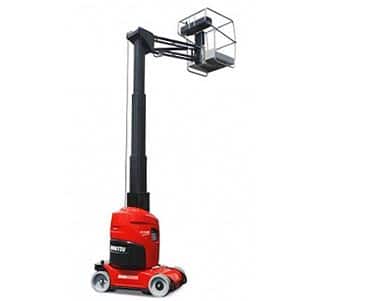
Aerial work platform training in English
This is a half-day aerial work platform course taught entirely in English, ending with a theory and practical exam. On passing, you receive a recognised operator certificate that is valid for 5 years and meets the requirements of the Dutch Working Conditions Act. The price is € 299 excl. VAT (€ 361.79 incl. VAT) per participant, course materials and exam included.
The course is designed for people who do not speak Dutch, or not well enough to follow safety instructions with confidence. Both the theory and the practical session are delivered in English, so nothing gets lost in translation. When you are working at height, understanding an instruction is very different from guessing at it.
No prior experience is required. The course suits participants with little or no experience and is built around practical work on the machine.
Target group and approach
- Little or no experience with aerial work platforms
- For companies and individuals
- Practice-oriented, instruction in English
Course at a glance
- Price: € 299 excl. VAT (€ 361.79 incl. VAT) per participant
- Duration: half a day
- Language: fully in English, theory and practical
- Prior knowledge: none required
- Course materials: included
- Exam: theory and practical, included
- Certificate: recognised operator certificate, valid for 5 years
- Locations: more than 15 training locations across the Netherlands
Who is this course for?
The course is aimed at companies with an international workforce and at individuals who do not speak Dutch.
- International workers in construction, industry and installation
- Migrant workers who operate at height and need certification
- Agency staff from abroad who need to be deployable
- Expats and foreign engineers working on Dutch projects
- Companies certifying a full team, including non-Dutch-speaking staff
If your employee does speak Dutch well, the Dutch beginners course at € 249 excl. VAT is the cheaper option.
Why take the training in English?
Safety instructions have to be understood, not just heard. Someone who follows only half the theory misses exactly the details that matter at height: the maximum ground slope, the wind limit and the correct use of fall protection.
There is a legal side to it as well. Article 8 of the Dutch Working Conditions Act (Arbowet) requires the employer to instruct employees effectively. Effectively means in a language the employee actually understands. Instruction given in Dutch to someone who does not speak Dutch does not meet that standard, even if a certificate is issued afterwards.
During an inspection, the Netherlands Labour Authority looks at demonstrable competence, not at paperwork.
What is an aerial work platform called in Dutch?
In Dutch an aerial work platform is called a hoogwerker. You will hear that word on every Dutch site, so it is worth knowing. The technical term MEWP (Mobile Elevating Work Platform) is used in the Netherlands as well.
The main types have their own Dutch names:
- Scissor lift: schaarhoogwerker
- Articulating boom lift or cherry picker: knikarmhoogwerker
- Telescopic boom lift: telescoophoogwerker
- Work platform or basket: werkbak
- Outriggers or stabilisers: stempels
We use both the English and the Dutch terms during the course, so you recognise them on site as well.
What will you learn?
The programme is identical to our Dutch beginners course, delivered in English.
- Theory: Dutch working conditions legislation, safety rules (A.I. 17), machine types, stability and wind limits
- Inspection: the visual check you carry out before every use
- Practical: positioning, setting outriggers, operating from the ground and from the platform, driving and manoeuvring
- Fall protection: correct use of harness and lanyard
- Emergencies: what to do in case of a failure, and how to use the emergency lowering system
- Exam: theory and practical, assessed in English
Two limits are covered in detail, because they are behind most incidents: the ground may slope no more than 5 degrees, and work must stop from wind force 6 upwards.
From booking to certificate in 3 steps
How long is the certificate valid?
The certificate is valid for 5 years and meets the requirements of the Dutch Working Conditions Act and of insurers. After that your employee takes the refresher course to recertify. The certificate may have expired by no more than 3 months at that point, otherwise the full beginners course has to be taken again.
You can read more about the legal background on our page about whether an aerial work platform certificate is mandatory.
Where can you take the course?
We run the course at more than 15 training locations across the Netherlands, including Amsterdam, Rotterdam, Tilburg and Zwolle.
Do you have several non-Dutch-speaking employees? We also come to your own site and train on your own machine. Request a quote for an on-site training or call +31 529 820 210.
Why choose NoRisk?
- Fully in English: theory, practical and exam, by an English-speaking instructor
- Everything included: course materials, exam and certificate are in the price
- Small groups: short waiting times and personal guidance
- Recognised certificate: valid for 5 years, accepted throughout the Netherlands
- 15+ locations: there is always a training site nearby
- On-site option: we train on your own machine, in your own working environment
- Assessment report: documented proof of competence for the employer
Frequently asked questions
What does the English aerial work platform course cost?
The course costs € 299 excl. VAT (€ 361.79 incl. VAT) per participant. Course materials, both exams and the certificate are included, so there are no separate costs afterwards.
What is an aerial work platform called in Dutch?
A hoogwerker. The technical term MEWP is used in the Netherlands as well. A scissor lift is a schaarhoogwerker, an articulating boom lift is a knikarmhoogwerker and a telescopic boom lift is a telescoophoogwerker.
Is the certificate the same as the one from the Dutch course?
Yes. You receive exactly the same recognised certificate, valid for 5 years and accepted throughout the Netherlands. Only the language of instruction differs.
Is the exam also taken in English?
Yes. Both the theory questions and the practical assessment are in English, so language is never the reason someone fails.
Does my employee need to speak Dutch?
No. The entire course is delivered in English. Basic working English is enough to follow the theory and the practical.
Do you also offer the course in Polish?
Our theory assessment is available in Polish. For a full course in Polish, please contact us so we can discuss what is possible for your team.
Can you deliver the course at our own site?
Yes. From a few participants onwards we come to your own location and train on your own machine. Your employees then practise in the exact situations they face every day, and you save on travel time.
Why is this course more expensive than the Dutch one?
The English course requires an English-speaking instructor and adapted course materials and exam papers. That is the difference between € 249 and € 299 excl. VAT.
How quickly can we start?
There is usually a place available within one to three weeks at a location near you. Urgent requests can often be scheduled sooner. Call +31 529 820 210 for current availability.
Is the certificate valid abroad?
It is recognised in the Netherlands and usually in Belgium. For international projects, clients often require an IPAF certificate instead. Read the full comparison on our page about the IPAF certificate.
What should your employee bring?
Valid photo identification, safety shoes and work clothing. If they have their own harness, they are welcome to bring it. Course materials are sent in advance.
What happens if someone fails the exam?
The instructor goes through what went wrong straight away. A resit is then scheduled at a reduced rate. The full course does not have to be taken again.
Do we receive proof of competence as an employer?
Yes. On request you receive an assessment overview per employee. Together with the certificate, that is documented proof of competence for the Netherlands Labour Authority and for your insurer.
Do you need a driving licence for an aerial work platform?
No. No driving licence is required to operate an aerial work platform on private premises. Valid photo identification is needed to take part in the course and the exam.
Questions? We are happy to help
Would you like more information about the English aerial work platform course, or would you rather have us come to your site? Call +31 529 820 210 or email info@hoogwerker-certificaat.nl. We are open from 08:30 to 17:00.
+31 529 820 210Email us